Attributes
Attributes are the properties or characteristics of an entity in a database. They represent the data stored about the entity and are implemented as columns in a table. Graphically represented as ovals or circles.
Here are examples of different types of attributes with explanations,
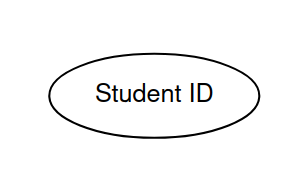
1. Simple Attribute
Definition: Cannot be divided into smaller parts.
Example:
Entity:
StudentAttributes:
StudentID,Name,AgeExplanation:
StudentIDis a simple, indivisible identifier for a student.
Table Example
CREATE TABLE Student (
    StudentID SERIAL PRIMARY KEY,
    Name TEXT NOT NULL,
    Age INT
);
2. Composite Attribute
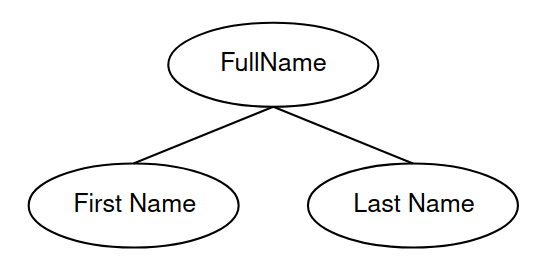
Definition: Can be divided into smaller sub-parts, each with independent meaning.
Example:
Entity:
StudentAttribute:
FullName(composed ofFirstNameandLastName)Explanation:
FullNamecan be divided intoFirstNameandLastName.
Table Example
CREATE TABLE Student (
    StudentID SERIAL PRIMARY KEY,
    FirstName TEXT NOT NULL,
    LastName TEXT NOT NULL
);
3. Derived Attribute
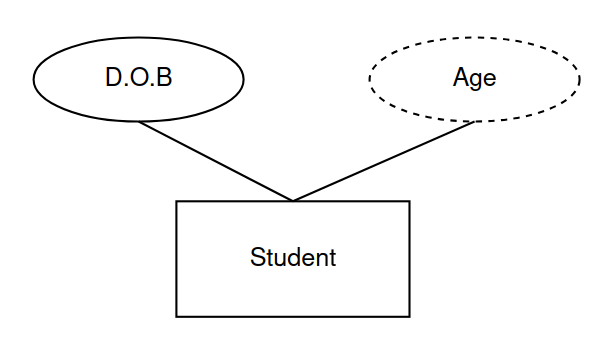
Definition: Can be calculated from other attributes.
Example:
Entity:
EmployeeAttributes:
DateOfBirth,AgeExplanation:
Ageis derived fromDateOfBirth.
Table Example
CREATE TABLE Employee (
    EmployeeID SERIAL PRIMARY KEY,
    Name TEXT NOT NULL,
    DateOfBirth DATE
);
-- Age can be calculated as:
-- SELECT DATE_PART('year', AGE(DateOfBirth)) AS Age FROM Employee;
4. Multivalued Attribute
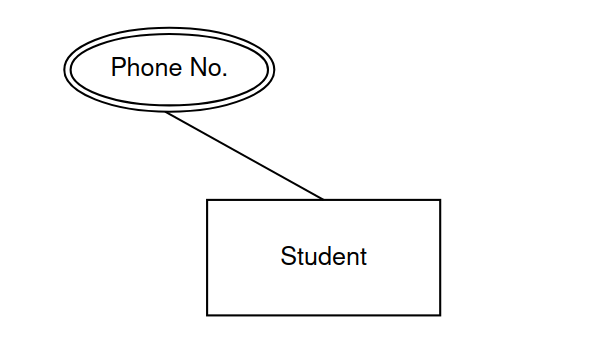
Definition: Can have more than one value for a single entity.
Example:
Entity:
StudentAttribute:
PhoneNumbers(a student may have multiple phone numbers)Explanation: A student can have a home phone and a mobile phone.
Table Example
To handle multivalued attributes, we use a separate table
CREATE TABLE Student (
    StudentID SERIAL PRIMARY KEY,
    Name TEXT NOT NULL
);

CREATE TABLE StudentPhone (
    StudentID INT REFERENCES Student(StudentID),
    PhoneNumber TEXT NOT NULL
);
5. Key Attribute
Definition: Uniquely identifies an entity in a table.
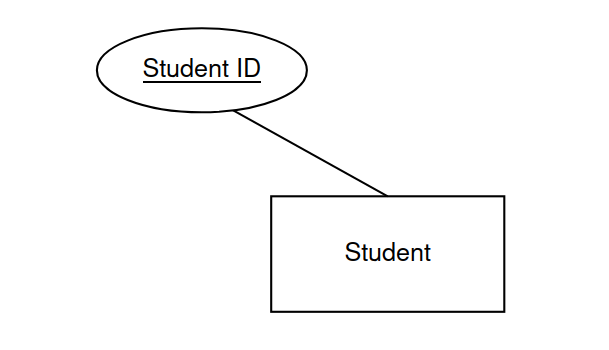
Example:
Entity:
StudentAttribute:
StudentIDExplanation:
StudentIDis a unique identifier for each student.
Table Example
CREATE TABLE Student (
    StudentID SERIAL PRIMARY KEY,
    Name TEXT NOT NULL
);
Summary
Type |
Description |
Example |
|---|
Simple |
Cannot be divided further. |
|
|---|
Composite |
Can be divided into sub-parts. |
|
|---|
Derived |
Calculated from other attributes. |
|
|---|
Multivalued |
Can have multiple values for one entity. |
|
|---|
Key |
Uniquely identifies an entity. |
|
|---|
Foreign Key |
References the primary key of another entity. |
|
|---|